


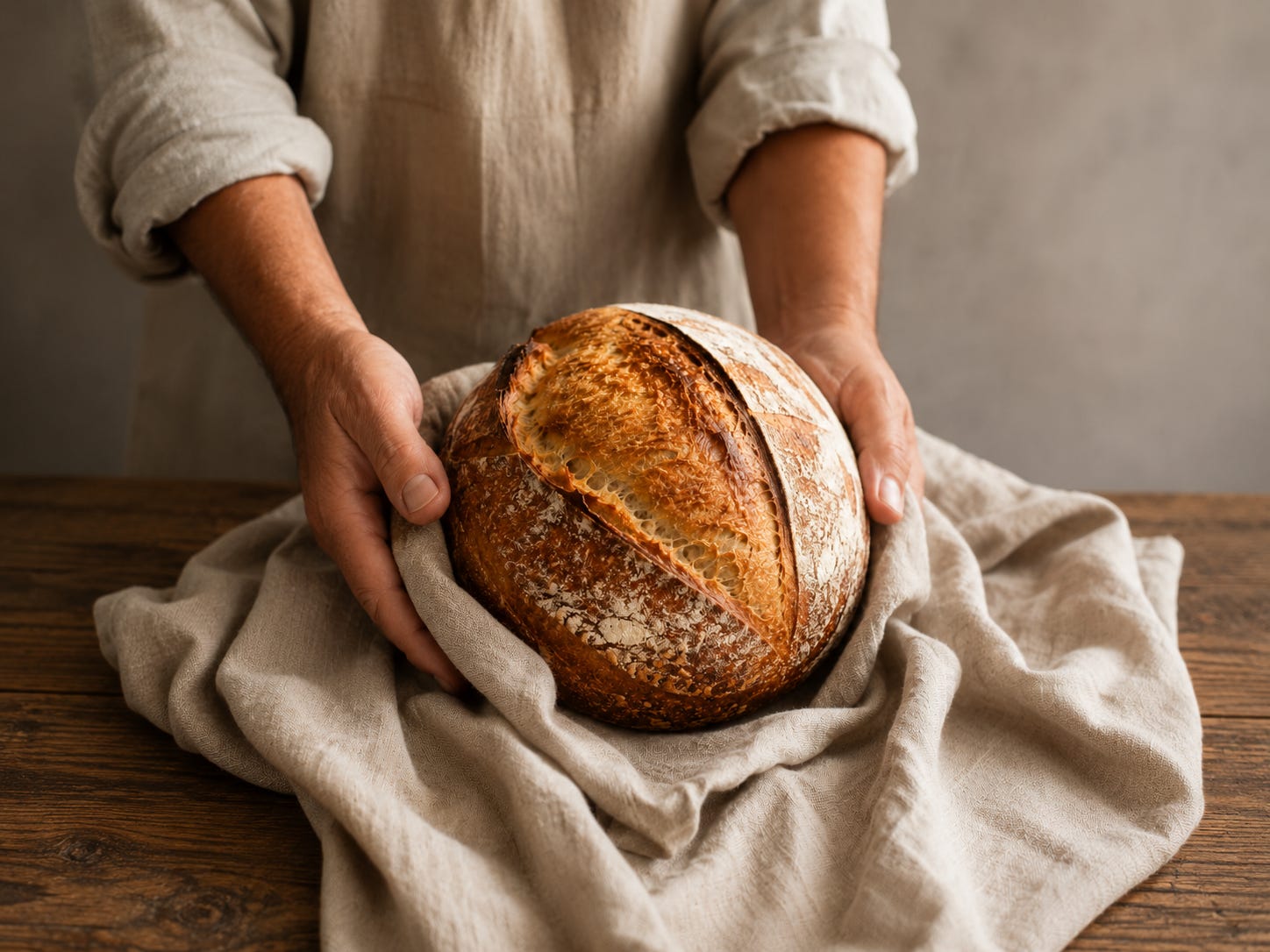
Jesus said, “I am the bread of life.”
In John 6, He does not leave the image there. He presses it further.
“I am the living bread which came down from heaven. If anyone eats from this bread, they will live forever. And the bread which I shall give is my flesh, given for the life of the world.”
Then later:
“Anyone who eats my flesh and drinks my blood remains in me, and I remain in them.”
And when His words become difficult to receive, He says:
“It is the Spirit who gives life; the flesh is no help. The words that I have spoken to you — they are spirit, they are life.”
I have been sitting with these words.
I understand, at least in part, that eternal life has something to do with resurrection, with the last day, with the life to come. But John’s Gospel does not speak of eternal life only as a future reality. Jesus speaks of it as something already given, already breaking into the present.
And that is where my question begins.
What is eternal life now?
What is the life Jesus offers in the here and now?
More honestly: if Jesus is the bread of life, why do I still feel hungry?
The Question I Have Carried
This is not a new question for me. In some form, I have been asking it for the last ten years.
Looking back, 2016 was a turning point in my life. It feels strange to say that now. A whole decade has passed. Not everything changed at once, but something began to shift then. That year became a doorway into a longer season of leaving, choosing, waiting, and being remade.
Over the years that followed, I walked away from an old relationship for various reasons. I walked away from a career path I had spent years building. I left my country. I entered a new relationship and eventually got married. I became a wife, but I remain childless. I pivoted toward church ministry, only to find myself now in the quieter, less defined space of being a housewife. I found myself living in a foreign country, learning to inhabit a life that was both given and unfamiliar.
So much of what once gave my life shape has been stripped, rearranged, or redefined.
At the time, perhaps I thought I was walking into something clearer. Something new, yes, but also something that would eventually make sense. Maybe the path would unfold. Maybe obedience would lead to an outcome I could recognize. Maybe the story would become easier to explain.
But ten years later, I am not sure I can say that.
I have a different perspective now. Maybe even a fuller one.
But not in the neat way I once imagined.
There are still questions I cannot answer. There are still longings that remain unmet. There are still parts of my life suspended between what I left behind and what has not yet come.
So when Jesus says, “I am the bread of life,” I find myself asking:
Lord, what difference has Your presence made?
Knowing God in the Unresolved Places
If I ask what the last ten years have taught me, I think one answer is this:
God has made Himself known to me in a deeper way.
Not mostly through clarity. Not mostly through answered prayers. Not through a life that became easier to narrate.
But through doubt.
Through questions.
Through uncertainty.
Through marriage.
Through migration.
Through unemployment.
Through childlessness.
Through the slow dismantling of identities I once knew how to inhabit.
I know God differently now than I did ten years ago. Not because I have mastered theology, but because life has pressed the questions into me. I no longer ask about faith only from the safety of abstraction. I ask from the middle of my own hunger.
And maybe that matters.
Maybe there is a kind of knowing that comes only when certainty has been loosened. Maybe there is an intimacy with God formed not when everything is resolved, but when we keep turning toward Him while nothing is resolved.
Still, the question remains.
If eternal life is already given, what does it look like in a life that still feels unfinished?
Eternal Life Is More Than Life After Death
In John’s Gospel, eternal life is not merely existence that goes on forever. It is not only a future destination, though it certainly includes the hope of resurrection.
Jesus says in John 17:3:
“This is eternal life: that they know you, the only true God, and Jesus Christ whom you have sent.”
Eternal life is knowing God.
Not merely knowing about Him. Not simply agreeing with doctrines about Him. But knowing Him through Jesus. Receiving Him. Trusting Him. Abiding in Him. Being drawn into communion with Him.
This means eternal life in the present is not first an improved circumstance.
It is communion.
It is participation in the life of God.
It is Christ giving Himself to us, not only as the One who will raise us on the last day, but as the One who sustains us now.
But this is where I have often struggled.
I may have assumed that if Jesus truly satisfies, then I should no longer ache so deeply. I should no longer feel the absence of what I prayed for. I should no longer thirst for a child, a vocation, a home, a rooted life, a clear way forward.
But perhaps that assumption needs to be questioned.
Maybe Jesus does not promise that every human hunger disappears.
Maybe He promises that no hunger will have the final word.
The Bread and the Hunger
The crowd in John 6 wanted bread.
Understandably so.
They were not wrong to be hungry. They were not wrong to need food. But Jesus presses them beyond the bread that fills the stomach for a day. He speaks of another bread. A living bread. A bread that comes down from heaven. A bread that is His own flesh, given for the life of the world.
He offers Himself.
And that is both beautiful and difficult.
Because sometimes I want Jesus to give me the thing I am hungry for.
Instead, He gives me Himself.
I do not want to make that sound more immediately comforting than it feels. There are days when “Jesus gives Himself” sounds like an answer that should be enough, but does not feel like enough. There are days when I know the theology, but still ache in the body.
So perhaps eternal life in the present does not mean, “I no longer hunger.”
Perhaps it means, “My hunger is held within a deeper life.”
Christ remains in me, and I remain in Him.
Even in lack.
Even in uncertainty.
Even when the life I imagined has not arrived.
The Spirit Who Gives Life
Jesus says, “It is the Spirit who gives life; the flesh is no help.”
That line can sound almost dismissive, especially when so much of our pain is embodied. But Jesus is not saying the body does not matter. He is not saying food does not matter, or fertility does not matter, or marriage does not matter, or grief does not matter.
The Gospel of John begins with the Word becoming flesh. Christianity does not despise embodied life.
So when Jesus says “the flesh is no help,” He is not rejecting the body. He is exposing the limits of life lived apart from the Spirit.
The flesh, in this sense, is human striving cut off from God. It is the attempt to secure life by control, achievement, explanation, or possession. It is life reduced to what we can manage, produce, preserve, or prove.
And perhaps this is part of what the last ten years have revealed in me.
I still want the story to justify itself.
I want to be able to look back and say, “This is why it had to happen. This is what God was doing. This is the fruit. This is the answer.”
But what if eternal life does not depend on my ability to make the story coherent?
What if life does not come from finally understanding the last ten years?
What if life comes from Christ Himself?
Not from the explanation.
Not from the outcome.
Not from the life I can secure.
But from Him.
Abiding, Not Arrival
John 6:56 says:
“Anyone who eats my flesh and drinks my blood remains in me, and I remain in them.”
The language is intimate and unsettling. Jesus is not asking merely to be admired. He is not presenting Himself as an idea to be considered from a distance. He is saying that His life must be received deeply, dependently, repeatedly.
Taken in.
Trusted.
Returned to.
And the result is abiding.
“…remains in me, and I remain in them.”
Maybe eternal life in the present feels less like arrival and more like abiding.
Less like certainty and more like remaining.
Less like finally having everything I long for and more like being held by the One who does not leave.
It is waking up still unsure and still turning toward Jesus.
It is not the absence of thirst.
It is the presence of the One whose words are spirit and life.
Still Being Fed
I still do not know how to make sense of the last ten years.
I still do not know what comes next.
But maybe eternal life in the present is not found in finally being able to explain my life.
Maybe it is found in this: that after everything, I am still here, still asking, still turning, still being fed by Christ in ways I may not yet know how to recognize.
The life Jesus gives is not always the life I imagined.
It is not always the life that resolves the ache.
But it is life.
Quietly.
Hiddenly.
Stubbornly.
Even here.