


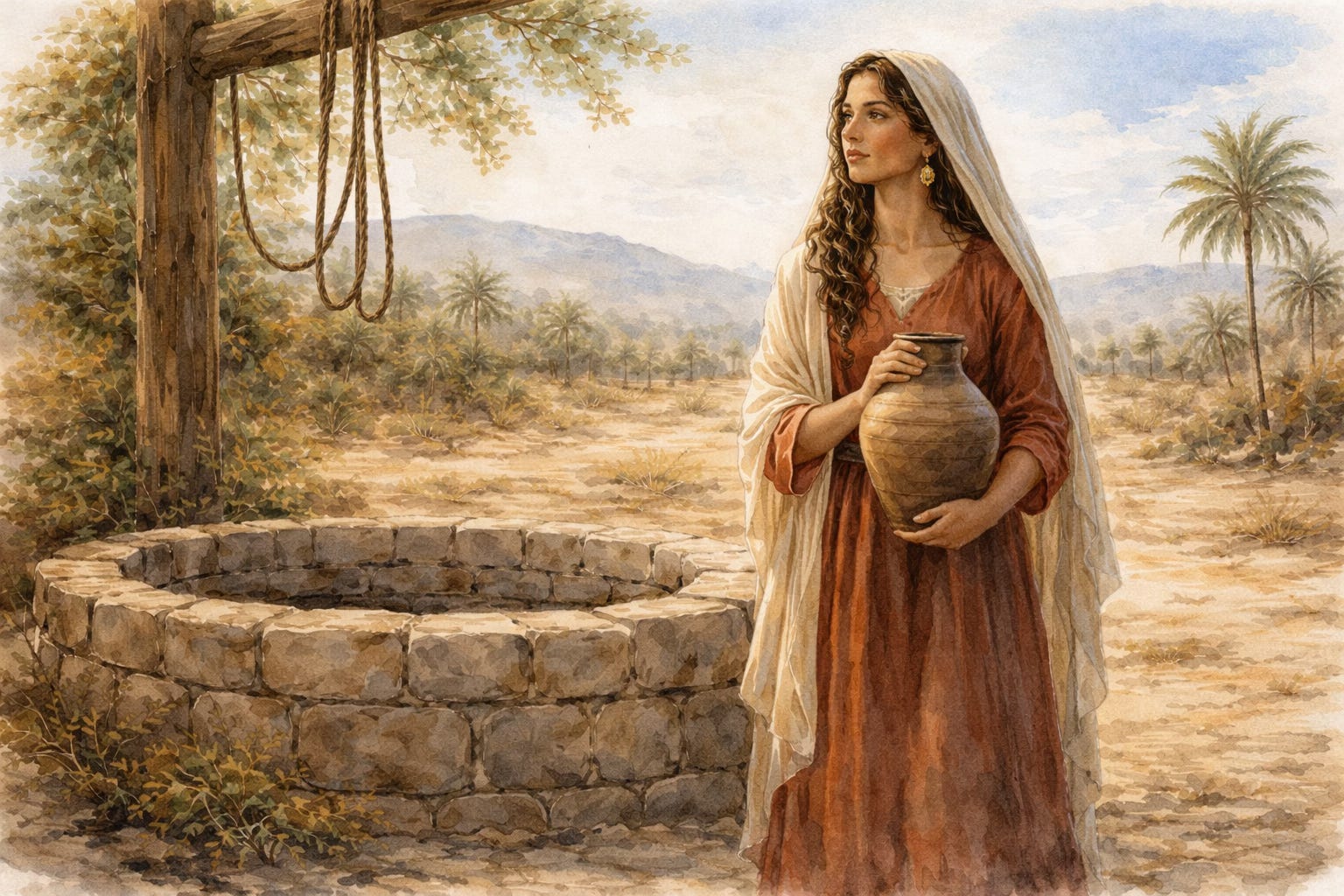
I was listening to the Gospel of John when the account of Jesus’ conversation with the Samaritan woman drew my attention. I continued listening to the chapters that followed, but my mind and heart had already stopped at that conversation.
It wasn’t the first time I had heard this story. But this time, it held me.
So I returned to it. I sat with it. I studied it.
The questions that came to mind were these:
Was there a movement to the Samaritan woman’s questions to Jesus? Why were those her questions? What was the movement of Jesus’ responses to her? And where do I situate myself in this story?
Naming the Movements
As I sat with the passage, I began to notice that this was not a random exchange. There was a movement both in the Samaritan woman’s questions and in Jesus’ responses.
The Movement of the Woman’s Questions
Her questions seem to unfold in a progression:
She begins with distance:
“Why are you talking to me?”
She names the boundaries — Jew and Samaritan, man and woman.She moves to challenge:
“Do you think you are greater than our ancestor Jacob?”
She is no longer just surprised; she is evaluating Jesus’ claim.Then to theological engagement:
“Where should we worship?”
Whether out of genuine curiosity or subtle deflection, she shifts the conversation to a longstanding religious debate.And finally to tentative openness:
“Could this be the Messiah?”
Not a declaration, but not dismissal either — a question that leaves space.
Her questions move from guarded distance → cautious engagement → partial recognition.
The Movement of Jesus’ Responses
Jesus’ responses move differently:
He begins with an invitation:
“If you knew the gift of God…”
He introduces a reality she does not yet understand.He then redefines her need:
Not physical water, but something deeper — living water that addresses a different kind of thirst.He moves to personal revelation:
Naming her life, not to condemn, but to uncover what lies beneath the surface.He then reorients her theology:
Moving the question from where to worship to how — in spirit and in truth.And finally, He gives direct self-revelation:
“I who speak to you am He.”
Jesus’ movement is from invitation → exposure → reorientation → revelation.
Placing Them Side by Side
When I place these movements side by side, something becomes clear:
She is moving toward understanding,
while Jesus is moving toward revealing.
She asks from within her framework,
while Jesus responds by expanding it.
She begins with categories — ethnic, social, theological —
but Jesus keeps drawing her beyond them.
But this is not just a pattern to observe. It is a conversation that takes place in a real moment, in a real place, under the heat of the day, beside a well.
The Setting: An Unexpected Encounter
We read of Jesus passing through Samaria on His way to Galilee. It says that He ‘had to’ go through Samaria.
Perhaps it was simply geographic.
Or perhaps it was something more, something intentional, even necessary, within His mission.
He and His disciples arrive at Sychar, a Samaritan village. Tired from the journey, Jesus sits beside a well while His disciples go into the village to buy food.
At noon, a Samaritan woman comes to draw water.
There is no explicit mention that Jesus was thirsty, yet He asks her for a drink.
She is surprised.
In my own words: “Why are you talking to me?”
She is a Samaritan. A woman. And she is alone at noon — a detail that quietly invites social and moral suspicion, since women typically came together earlier or later in the day to draw water.
So her question is not casual. It is boundary-setting.
Misunderstanding and Invitation
Jesus responds:
“If you only knew the gift of God and who it is that is speaking to you, you would have asked me, and I would have given you living water.”
Her reply, again in my own words:
“Who do you think you are? Do you think you are greater than our ancestor Jacob? You don’t even have anything to draw water with, how can you give me water?”
Jesus clarifies:
“Everyone who drinks this water will be thirsty again, but whoever drinks the water I give will never thirst…”
At this point, something may be stirring in her.
She asks Him for this water — so she will not be thirsty and will not have to keep coming back to the well.
But she still seems to be thinking in physical terms. The mention of eternal life does not fully register. Her response carries a mixture of openness and misunderstanding. At this stage, we cannot be entirely certain.
Being Known Without Condemnation
Then Jesus shifts the conversation:
“Go, call your husband.”
She replies that she has no husband.
Jesus affirms this and reveals her relational history.
Notably, there is no explicit condemnation.
At this point, two things seem to happen.
First, she may feel exposed — and so she deflects.
Second, she turns to theology.
From Debate to True Worship
She acknowledges Jesus as a prophet and raises a longstanding dispute:
Where is the proper place of worship? Mount Gerizim or Jerusalem?
It is striking that she returns to the same boundary markers she raised at the beginning.
But Jesus does not engage the debate on its terms.
He reframes it entirely:
The time is coming — and is now here — when true worshipers will worship the Father in spirit and in truth.
Worship is no longer about location. It is about relationship and reality — about being drawn into what God Himself is doing.
Revelation to the Unexpected
She says:
“I know that Messiah is coming…”
And Jesus responds:
“I who speak to you am He.”
This direct self-revelation is given not to a religious leader, not to a disciple, but to a Samaritan, a woman, an outsider.
From Encounter to Invitation
She leaves her water jar — seemingly forgetting the very reason she came to the well — and returns to the village.
She tells the people:
“Come, see a man who told me everything I ever did. Could this be the Messiah?”
In Greek, the phrasing suggests hesitation:
“This couldn’t be the Messiah… could it?”
She does not sound certain, even after Jesus’ own self-revelation.
And yet, she goes.
She tells others.
She invites them to see for themselves.
A Witness Still in Process
I found myself wondering why she is often described as the first evangelist.
She does not present a clear confession.
She does not offer a structured theology.
She does not even sound convinced.
And yet, because of her invitation, many Samaritans come to Jesus.
They first believe because of her testimony. But then they say:
“Now we believe… because we have heard for ourselves.”
They arrive at their own conviction.
Locating Myself in the Story
And perhaps this is where I begin to situate myself in the story.
I recognize something of her in me.
The questions that begin with distance.
The need to evaluate before trusting.
The tendency to move into theology when things feel too personal.
The slow, uneven movement toward recognition.
Jesus does not wait for clarity before engaging her.
He meets her in the middle of her questions.
She may have been coming to that well daily, weary of having to come at noon just to avoid the stares, the murmurs, the distance others kept. Or perhaps it was the first time she came alone, after enduring judgment she could no longer bear.
But Jesus met her there.
Not by accident. Not as interruption.
He met her when she did not plan it,
when she did not expect it,
when she was not ready.
And still — she went back and invited others.
Come and See
What if faith is not defined by how clearly we can explain Jesus,
but by whether we are willing to return to the village and say,
“Come and see.”